
A damaged car that can still roll may need a different transport plan from one that cannot move on its wheels. The safest approach to damaged car transport depends on the vehicle’s condition, not simply on the fact that it has been damaged.
It’s understandable to worry about whether your car can be loaded as it is, or whether moving it could cause further damage. It also helps to distinguish accident recovery, arranged after a collision, from planned transport to a destination you choose.
This guide explains how to match the transport approach to your vehicle and circumstances, what details to prepare before collection, and what to expect through to delivery. YSF Recovery provides non-impound accident recovery and UK-wide transport, including recovery for rolling cars and light vans that don’t require skates. We’ll also cover direct delivery to your chosen destination, so you can make a clear plan for your damaged vehicle.
Key Takeaways
- For damaged car transport, the vehicle’s condition and ability to roll help determine a suitable loading plan.
- Accident recovery suits an unexpected collision, whilst planned transport is arranged around a chosen collection point and destination.
- Before collection, share clear details about the damage, whether the vehicle rolls, and access at both locations.
- YSF Recovery provides non-impound accident recovery, taking the vehicle directly to your chosen destination.
- Rolling vehicle recovery is available for standard cars and light vans that do not require skates.
Damaged car transport: what the vehicle’s condition tells you
Damaged car transport is the planned movement of a vehicle that has been involved in a collision or otherwise damaged. The car’s condition helps determine how it can be loaded and moved, including whether it can roll safely at collection. A dent or cracked bumper alone won’t answer that question. More useful details are whether the wheels turn, whether the steering works and whether the vehicle can be moved without worsening the damage.
The transport method should follow the vehicle’s condition and ability to roll, not its appearance alone. This is a practical starting point, not a diagnosis. A short description or photograph can help explain what you can see, but it cannot establish exactly how the car will load. An overview of towing methods provides general background; the vehicle’s condition and collection location are what matter when planning its move.
What counts as a damaged car for transport purposes?
Some damage is mainly visible. A dented door or scraped bumper may look serious but not affect how the vehicle moves. Other signs may affect loading, such as a wheel that appears displaced, steering that doesn’t respond normally, or a loose part hanging close to the ground. These examples don’t confirm what is wrong. They help identify details to share when arranging transport.
Describe what you can observe, including which area is damaged and whether anything is obstructing a wheel. Don’t try to test the car if doing so could be unsafe. The transport plan depends on its condition at collection, so report any changes since your first description, such as a wheel becoming harder to turn.
Why does it matter whether the car can roll?
Here, a rolling vehicle means one whose wheels can roll so it can be loaded without skates. That doesn’t necessarily mean it starts, drives or is safe to use on the road. A car may not start but still roll; a damaged wheel or another obstruction may prevent it from moving freely.
YSF Recovery handles rolling cars and light vans that can be recovered without skates. This approach isn’t suitable for every immobilised or severely damaged vehicle. If the car won’t roll, or you’re unsure whether it can move safely, explain that clearly rather than trying to shift it yourself. Share details such as:
- Whether the vehicle starts, if known, and whether each wheel appears able to roll.
- Any visible damage to the wheels, steering, underside or bodywork.
- Loose parts, fluid on the ground or other obstacles around the vehicle.
- Where it is positioned and any access restrictions at collection.
Clear information helps shape a suitable collection plan and reduces guesswork. It gives the recovery team a more useful picture than appearance alone, without asking you to diagnose the damage or move an unsafe car.
How damaged car transport works from collection to delivery
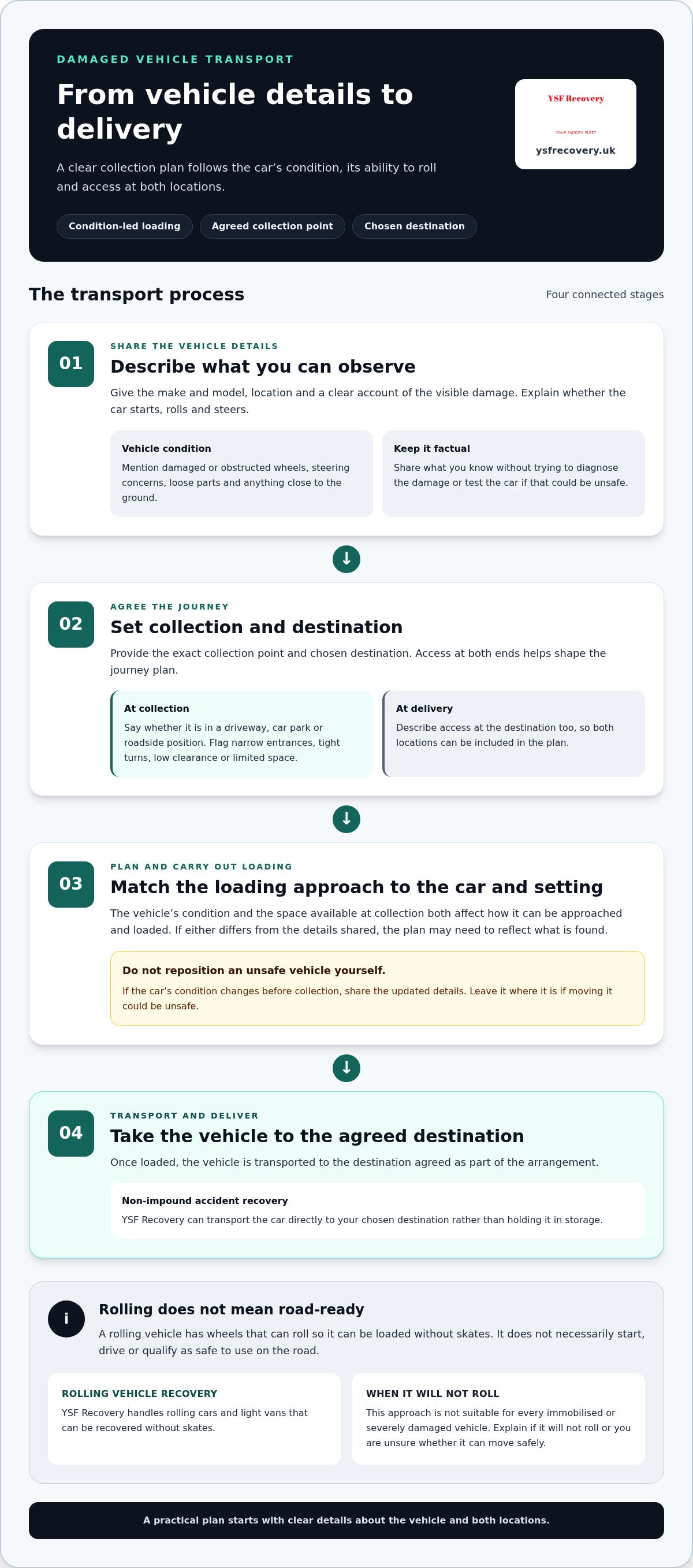
Arranging damaged car transport is easier when the key details are clear from the start. The vehicle’s condition, collection location and delivery access all help shape the plan. The process is straightforward: share information, agree the journey, load the vehicle and deliver it to the agreed destination. There’s no need to move a car that may be unsafe just to make collection easier.
- Share the vehicle details. Give the make and model, its location and a clear account of the visible damage. Explain whether it starts, rolls and steers, and mention any wheel that appears obstructed or damaged. These details help build a practical picture before collection.
- Agree collection and destination. Provide the exact collection point and your chosen destination. Describe access at both ends, including narrow entrances, tight turns, low clearance or limited space to position the vehicle. This helps account for the setting as well as the car.
- Plan and carry out loading. The loading approach needs to suit the vehicle’s condition and the space available at collection. If the car’s condition or access differs from what you described, that may affect how it can be approached and loaded. Don’t attempt to reposition an unsafe vehicle yourself.
- Transport and deliver. Once loaded, the vehicle is taken to the agreed destination. With YSF Recovery’s non-impound accident recovery, the car can be transported directly to your chosen destination rather than held in storage.
What details help plan a damaged car collection?
Be specific about what you know without trying to diagnose the damage. For example, say that the front bumper is damaged, the car doesn’t start, and you don’t know whether the front wheels roll freely. Note whether it steers, and mention loose parts, visible obstructions or a wheel that looks out of position. Clear facts are more useful than a guess about what is wrong.
Access details matter too. Explain whether the vehicle is in a driveway, car park or roadside position, and flag any tight space or restricted entrance. Give the same practical information for delivery so the destination can be included in the journey plan.
What happens during loading and delivery?
Loading arrangements depend on the vehicle and the collection setting. A car with clear access and wheels that roll presents different practical conditions from one that is obstructed or difficult to move. Share any changes in its condition before collection, and leave the vehicle where it is if moving it could be unsafe. The plan should reflect the car as found, rather than assume every damaged vehicle can be handled in the same way.
For non-impound accident recovery, the destination is part of the arrangement from the outset. Decide where the vehicle needs to go and describe access there. If you’re arranging a move for a damaged vehicle, YSF Recovery’s vehicle transport provides a direct route from collection to your chosen destination.
Recovery or planned transport: which option fits a damaged car?
The right option depends on why the vehicle needs moving and how soon it needs to leave its current location. Accident recovery is arranged after a collision when the car needs to be removed and taken somewhere suitable. Planned transport is arranged for a relocation between chosen places. Breakdown recovery is different again: it’s for a vehicle that can’t continue its journey because of a fault.
Use this comparison to identify the purpose of the move. The car’s condition and ability to roll matter for either option, so urgency alone won’t determine how it can be loaded.
Purpose: Non-impound accident recovery moves a vehicle after a collision. Planned transport relocates a vehicle between locations chosen by its owner.
Vehicle condition: For either journey, explain whether the car starts, rolls and steers, and describe any visible damage or wheel obstruction. A vehicle that cannot move safely needs a plan based on its condition, not assumptions.
Urgency: Accident recovery addresses the need to move a car following an incident. Planned transport is organised around a relocation rather than an immediate collision response. Breakdown recovery applies when a vehicle cannot continue because of a fault.
Destination planning: Decide where the vehicle should go. With YSF Recovery’s non-impound accident recovery, it can be taken directly to your chosen destination. For planned transport, the collection and delivery points form part of the arrangement.
When does accident recovery make sense?
Accident recovery is a practical option when a non-impounded vehicle needs moving after a road collision. It separates the task of transporting the damaged car from decisions about repairs or what happens next. Before the move begins, decide where the vehicle should be delivered, such as a location you’ve chosen for its next steps. The guide Non-Impound Accident Recovery: Complete UK Guide covers this option in more detail.
When is planned vehicle transport a better fit?
Planned transport suits a non-emergency relocation, such as moving a vehicle between two chosen locations. The journey can be arranged around where the car is and where it needs to go. Its condition, ability to roll and access at both ends remain relevant to the loading plan. YSF Recovery provides UK-wide long-distance transport; see Long Distance Car Transport UK: The Complete Guide for broader journey planning.
In short, choose according to the circumstances: a collision points towards accident recovery, while a planned relocation points towards vehicle transport. If the car has broken down, describe that clearly too, as breakdown recovery addresses the separate problem of a vehicle unable to continue. For damaged car transport, a clear destination and an accurate account of the vehicle’s condition help establish which arrangement fits.
Prepare a damaged car for transport with this practical checklist
A little preparation can make collection more straightforward. For damaged car transport, accurate details are more useful than guesses about what is wrong. Don’t start the vehicle, test the steering or try to reposition it if that could put you at risk or worsen the damage. Your safety comes first, especially if the car is at the roadside. Follow current official UK roadside safety advice and any instructions from the emergency services.
Before collection, note what you can safely observe and have the journey details ready. Use this checklist:
- Describe the damage: Say which areas are affected, such as a damaged front wing, a loose bumper or visible damage near a wheel. Report anything that looks out of position without trying to diagnose it.
- Explain how the car moves: If known, state whether it starts, rolls and can be steered. Mention any wheel that appears blocked or damaged. Don’t test these if it would be unsafe.
- Give the collection details: Provide the precise location and explain access limits, such as a narrow entrance, tight turn or restricted space.
- Confirm the destination: Give the full delivery address and flag any access restrictions there too.
- Gather what’s useful: Have the keys and vehicle details ready if they’re accessible. Remove personal belongings only if it’s safe and practical to do so.
What should you tell the recovery team?
Be clear about what you’ve seen and what you don’t know. For example, explain that the car’s front corner is damaged, it won’t start, and you haven’t tried to check whether the wheels roll. This gives a more useful picture than saying only that the car is damaged. Include any changes since the incident and any access issue that could affect collection or delivery.
What should you do before collection?
Put the vehicle details, keys and destination information together if you can do so safely. Don’t enter a dangerous area or move the car to make access easier. Personal belongings can wait if reaching them is difficult or unsafe. Leaving the vehicle where it is and reporting the conditions clearly helps the recovery team plan around the situation.
Once you have the details to hand, arrange damaged car transport with YSF Recovery. For non-impound accident recovery, the vehicle can be taken directly to your chosen destination.
Arrange damaged car transport with YSF Recovery across the UK
YSF Recovery provides UK-wide vehicle recovery and transport for damaged cars. The right arrangement depends on why the vehicle needs moving and how it can be handled at collection. After a non-impound collision, accident recovery takes the vehicle directly to your chosen destination. For a suitable rolling car or light van, the rolling-vehicle service is for vehicles that do not require skates.
These services focus on moving the vehicle, not repairing or storing it. Sharing accurate details about its condition and the journey helps make the collection plan practical from the outset.
What YSF Recovery can help with
Non-impound accident recovery is an option when a vehicle needs to be moved following a collision. Rather than being held in storage, it can be transported directly to the destination you choose. This gives you a clear next step for the vehicle, whether you’re arranging its onward handling or simply need it moved from the incident location.
YSF Recovery also handles rolling vehicle recovery for standard cars and light vans that don’t require skates. Visible damage alone doesn’t determine whether this approach is suitable. The vehicle’s ability to roll and the conditions at collection matter, so describe what you can safely observe when arranging transport.
What information to have ready when arranging transport
Before you get in touch, gather the details that help explain the vehicle and its journey. You don’t need to diagnose the damage. A straightforward account of what happened and what you can see gives the transport team a useful starting point.
- Vehicle details: Make, model and exact location.
- Condition: Visible damage, plus whether it starts, rolls or steers, if known. Note any wheel that appears blocked or damaged.
- Collection access: Explain where the vehicle is and mention tight entrances, restricted spaces or other obstacles.
- Destination: Provide the full delivery address and note any access limits there.
- Practical details: Have the keys ready if accessible, but don’t enter an unsafe area or move the vehicle to retrieve them.
Clear information helps match the collection plan to the vehicle and its surroundings. If its condition changes before collection, share the update. Don’t try to move a car if doing so could be unsafe.
For UK-wide damaged car transport, share the vehicle’s location, condition and chosen destination with YSF Recovery. Speak to YSF Recovery about moving your damaged car.
Take the next step with a clear transport plan
A damaged vehicle can leave you with several decisions to make. Start with the one that helps everything else fall into place: where does the car need to go, and what can you safely tell the recovery team about its condition? You don’t need to diagnose the damage. Clear, practical information gives the transport arrangement a sensible starting point.
For damaged car transport across the UK, YSF Recovery provides vehicle recovery and transport, including non-impound accident recovery with delivery to your chosen destination. Rolling vehicle recovery is available for cars and light vans that don’t require skates. The right approach still depends on the vehicle and its circumstances.
Gather the location, destination and details you can safely observe. Then take the next step with a clear plan. Arrange damaged car transport with YSF Recovery and move forward knowing what information to share.
Frequently Asked Questions
Can a damaged car still be transported if it will not start?
Yes, a car that won’t start may still be transportable; whether it can be loaded depends on its condition. A non-starting engine doesn’t necessarily stop the wheels from rolling, but damaged or obstructed wheels can affect the loading plan. Tell the recovery team what you know and avoid testing the vehicle if it may be unsafe. YSF Recovery also provides breakdown and home start assistance.
Can you transport a car with accident damage?
Yes. YSF Recovery provides non-impound accident recovery for damaged vehicles and can take the car directly to your chosen destination. Describe the damage clearly, including any loose bodywork, visible fluid or parts near the wheels. Don’t assume a car is suitable to move just because the damage looks minor. The transport arrangement should reflect the vehicle’s condition, not only its appearance.
How do I arrange transport for a damaged car?
Share the vehicle’s location, make and model, destination, and a plain description of what happened. Explain whether it starts, rolls or steers, based only on what you can safely observe. Mention anything that could affect access, such as a narrow driveway or a locked entrance. These details give YSF Recovery a useful starting point for arranging damaged car transport around the vehicle and journey.
Does damaged car transport include taking the vehicle to my chosen destination?
Yes. YSF Recovery’s non-impound accident recovery takes the vehicle directly to the destination you choose, rather than holding it in storage. Decide where you want the car delivered before the move, then provide the full address and any access information. For example, mention a shared entrance or limited turning space. A clear destination helps define the journey from the outset.
How much does damaged car transport cost in the UK?
The cost depends on the individual move, so there isn’t a reliable figure to give without details of the vehicle and journey. The distance between collection and delivery, the car’s condition and access at each location can all affect the arrangement. Provide the collection point, destination and an accurate description of the damage to help establish the requirements for your transport.
Can a damaged car be transported without using skates?
Yes, YSF Recovery handles rolling cars and light vans that can be recovered without skates. This applies to vehicles that can roll, not every damaged or immobilised car. A vehicle that won’t start may still roll, whilst an obstructed wheel can change the situation. Describe what you can safely observe so the vehicle’s condition is clear when arranging recovery.
Should I remove belongings from a damaged car before transport?
Remove personal belongings if you can do so safely and without delaying any immediate safety measures. Prioritise valuables, important documents and items you’ll need during the journey. Don’t enter a vehicle or roadside area if it feels unsafe, and don’t try to move the car to reach something inside. If belongings must remain in the vehicle, mention this when arranging collection.


