
A car that won’t start isn’t always difficult to move. The key question is whether it can roll and steer. If you’re wondering how to transport a non-running car, that distinction helps determine a suitable loading method and what to tell the recovery operator before collection.
It can be hard to know whether a car can be moved safely, what equipment may be needed or which details to share when arranging transport. A vehicle that won’t start but can roll is different from one with seized brakes, steering problems or accident damage. Describe what you know about its condition and the access to the collection point so the move can be planned accordingly.
This guide explains what to check, how to prepare the car and collection point, and which transport methods may suit different conditions. YSF Recovery transports non-starting vehicles from driveways or roadside locations to a designated garage across the UK. Its rolling-vehicle recovery is for vehicles that can be winched or loaded without skates.
Key Takeaways
- Check whether the car can roll and steer, not only whether its engine starts.
- Learn how to transport a non-running car by matching its condition to a suitable loading method.
- Share details such as wheel movement, handbrake position, keys and visible damage before collection.
- Describe the access route and collection area so the recovery vehicle can approach the car safely.
- Rolling-vehicle recovery may suit a car that can be winched or loaded without skates.
How to transport a non-running car: first identify what has stopped working
A car that won’t start can leave you unsure what to arrange next. Begin with what the vehicle can do, not just the suspected fault. A flat battery presents a different loading situation from a wheel that won’t turn or steering that won’t respond. Describing the car’s condition helps identify a suitable approach before transport is arranged.
When working out how to transport a non-running car, separate two questions: can it drive under its own power, and can it roll and steer? A car may not be able to move itself but could still be loaded as a rolling vehicle. That distinction can affect the loading method and equipment required.
What does non-running mean when arranging car transport?
“Non-running” means the car can’t be driven under its own power. It doesn’t tell you whether the wheels turn or whether the vehicle can be guided into position. A failed battery or engine fault may stop the car starting, while a seized wheel may prevent it rolling. Collision damage can also affect the wheels, steering or bodywork. Describe what you can see rather than guessing at the cause.
Transport requirements depend on whether the car rolls and steers, not simply on whether its engine starts. For a general overview of towing methods and equipment, see the different approaches used to move vehicles.
Which vehicle details affect collection and loading?
Before arranging collection, note what you know about the car’s movement and controls. Don’t force a wheel, steering wheel or gear selector to test it. If the vehicle is in an unsafe position or visibly damaged, leave it as it is and report its condition. Clear, accurate details help match the loading approach to the vehicle.
- Wheels: Can they rotate freely, or does one appear locked, damaged or obstructed?
- Steering: Does it turn, or is it stiff, damaged or unresponsive?
- Handbrake: Is it on, released or stuck? Don’t assume it can be released safely.
- Transmission: Is the car in neutral, park or another known position? Mention if you can’t change it.
- Keys: Are they available to access the vehicle or operate its controls?
- Visible damage: Describe damage to the wheels, tyres, steering, bodywork or underside.
Explain where the car is, such as on a driveway or at the roadside, and mention anything that could restrict access. A car with a flat battery may still roll if its wheels and steering work. Locked wheels or collision damage can call for a different loading plan. Don’t try to move the car yourself if you’re unsure. Accurate observations are more useful than a risky test.
How non-running car transport works: loading, securing, and moving the vehicle
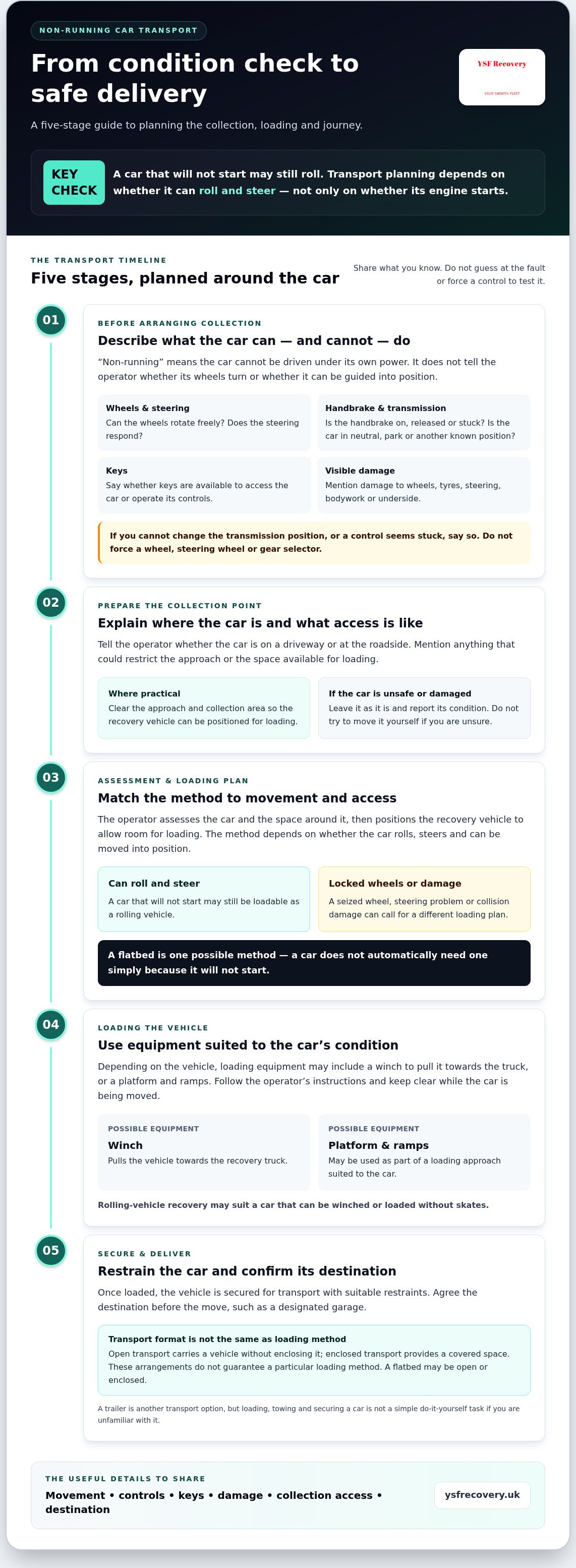
Once the vehicle’s condition is clear, the move can be planned in stages. The recovery operator needs to know what the car can do and where it is positioned. These details help determine how to approach it, load it and secure it for the journey. A flatbed is one possible method, but a car doesn’t automatically need one just because it won’t start.
The loading method depends on whether the car can roll, steer and be moved into position. A vehicle with a failed battery may be loadable differently from one with locked wheels or collision damage.
What happens when a car is loaded onto a recovery vehicle?
The process begins with an assessment of the vehicle and the access around it. The recovery truck is positioned to allow room for loading. Depending on the car’s condition, equipment may include a winch, which pulls the vehicle towards the truck, or a platform and ramps. The car is then secured for transport with suitable restraints.
The approach depends on details such as whether the wheels turn, the steering works and the vehicle can move freely. Don’t try to push or drive the car onto a truck yourself. Follow the operator’s instructions and keep clear of the loading area while the vehicle is being moved.
When might a flatbed or trailer be considered?
A flatbed carries the car on a platform rather than with its wheels on the road. It may be used for a vehicle that can’t be driven, but the method still needs to suit the car’s condition and how it can be loaded. A trailer is another way to transport a vehicle. It isn’t a simple do-it-yourself option if you’re unfamiliar with loading, towing and securing a car.
Open transport carries a vehicle without enclosing it, while enclosed transport provides a covered space. These are broad transport arrangements, not a guarantee of a particular loading method. The car’s condition, access and transport needs all matter. A flatbed may be open or enclosed, and a non-runner doesn’t automatically need enclosed transport.
In practical terms, the process is:
- Share the condition. Describe what works, what doesn’t and any visible damage.
- Prepare access. Clear the approach and collection area where practical, and mention any restrictions.
- Load the car. The operator uses a method suited to its movement and condition.
- Secure it. The vehicle is restrained on the recovery vehicle for the journey.
- Deliver it. Agree the destination, such as a designated garage, before the move.
If the car won’t start but can be winched or loaded without skates, YSF Recovery’s UK-wide vehicle recovery and transport can move it from a driveway or roadside location to a designated garage. Sharing accurate details at the outset helps the collection plan reflect the car’s condition.
Can a non-running car be moved without skates? Match the method to its condition
“Non-running” describes whether the car can drive itself. It doesn’t tell you whether the wheels turn or the steering works, and that distinction matters when deciding how to load it. A car that won’t start may still be movable as a rolling vehicle. One with locked wheels or restricted steering presents a different recovery requirement.
Use this comparison to describe the vehicle’s condition:
- Starts and drives: The car can move under its own power. If it needs transport for another reason, explain why it can’t be driven to its destination.
- Won’t start, but rolls and steers: The engine or battery may have failed while the wheels still turn and the steering responds. It may be possible to winch or load the vehicle without skates.
- Can’t roll or steer: Locked wheels, restricted steering or serious collision damage can affect how the car is approached and loaded. This is different from a standard rolling-vehicle move without skates.
Don’t assume the cause of the breakdown tells you how the car will move. Describe what you can observe. If you’re unsure, say so rather than trying to force the wheels or steering.
Can a car that will not start still be a rolling vehicle?
Yes. Starting and rolling are separate conditions. For example, a car with a flat battery may not start, but its wheels may still rotate and its steering may still work. If it can be winched or loaded without skates, it may fit the rolling-vehicle category. YSF Recovery’s rolling-vehicle recovery is designed for vehicles that can be loaded without skates. The car’s actual condition still matters when planning the loading method.
What if the wheels are locked or the steering will not turn?
A locked wheel can prevent the car from rolling as expected. Steering that won’t turn can make it harder to guide the vehicle into position, and serious damage may affect both. Report these issues before arranging collection, and explain which wheel or control is affected if you know. Don’t try to release a stuck handbrake or force a damaged part. These conditions may need a different recovery approach from a rolling-vehicle move without skates.
To work out how to transport a non-running car, focus on what the vehicle can safely do rather than trying to diagnose the mechanical fault. Share whether it starts, whether the wheels rotate, whether the steering turns and any visible damage. If its wheels and steering work, YSF Recovery can transport non-starting vehicles that can be winched or loaded without skates. YSF Recovery’s rolling-vehicle recovery is for suitable vehicles collected from a driveway or roadside location and taken to a designated garage.
How to prepare a non-running car for collection in the UK
A few clear details help the recovery operator plan the collection and choose an appropriate loading approach. You don’t need to diagnose the fault. Focus on what you can see, what the car can do and how the collection point is laid out. If you’re unsure about something, say so rather than testing the car in a way that could be unsafe.
What information should you share before collection?
Use this checklist to share the essential details about the vehicle and access before collection. Keep it factual and concise. The aim is to describe the car, not guess why it has stopped working.
- Starting: Does the engine start, or is the car completely non-starting?
- Wheels and steering: Do the wheels appear able to turn, and does the steering respond?
- Handbrake: Is it on, off or stuck, if you know?
- Transmission: What position is it in, and can it be shifted out of gear or park?
- Keys: Are the keys available? Mention if they’re missing or the car can’t be unlocked.
- Damage and clearance: Note collision damage, a low front end or anything that could restrict loading.
- Location: Give the precise collection point and describe any narrow entrance, steep slope or limited room to manoeuvre.
For example, “The engine won’t start, the steering turns, the handbrake is off and the car is on the left side of the driveway” gives a clearer picture than “It’s broken down”. If you don’t know whether a wheel turns or the transmission can be moved, don’t force it. Report only what you can confirm.
How can you make the collection point easier to access?
Where it’s practical and safe, clear loose items from the route to the car and make its exact position easy to identify. Tell the operator about gates, tight turns, parked vehicles, overhanging branches or other obstacles that could limit access. A narrow driveway or steep slope can affect where a recovery vehicle can position itself.
For a roadside collection, describe the car’s position and any nearby hazards or access restrictions. Don’t put yourself in traffic or attempt to push, steer or reposition a vehicle that may be unsafe. Leave it where it is and pass on the relevant information so the collection can be planned around the conditions.
Preparing the car doesn’t mean making it ready to drive. It means giving an accurate account and keeping the collection area as accessible as you safely can. These steps can reduce uncertainty on arrival and help match the loading plan to the vehicle.
YSF Recovery transports non-starting vehicles from driveways or roadside locations to designated garages. Arrange transport for your non-running car with the collection details ready.
Arrange non-running car recovery with YSF Recovery
A car that won’t start may still be able to roll. If its wheels can move and it can be winched or loaded without skates, rolling-vehicle recovery may be suitable. Locked wheels, restricted steering or significant damage can mean the vehicle needs a different recovery approach. Describe its actual condition clearly instead of assuming every non-runner needs the same equipment.
When is YSF Recovery’s non-running vehicle service relevant?
YSF Recovery transports non-starting vehicles from driveways or roadside locations to designated garages. This can help when a breakdown or home-start issue means the car can’t be driven and needs to be moved. Its rolling-vehicle recovery is designed for vehicles that can be winched or loaded without skates. Whether the car suits that method depends on how it can move and be loaded, so give an accurate description when arranging recovery.
Share these details to explain the situation clearly:
- What has stopped working: Say whether the car starts or can be driven.
- How it moves: Describe whether the wheels turn and the steering works.
- What may affect loading: Mention a stuck handbrake, transmission that can’t be shifted, missing keys or visible damage.
- Where it is: Give the collection location and note access restrictions or limited space.
- Where it needs to go: Identify the designated garage or other agreed destination.
What is the next step for arranging vehicle recovery?
Gather the vehicle and collection details before arranging transport. You don’t need to identify the mechanical fault if you don’t know what caused it. A straightforward account of what the car can do is more useful. For example, explain that it won’t start, the wheels appear to roll, the steering works and the car is on a driveway with a narrow entrance. If a detail is uncertain, say so rather than testing it.
YSF Recovery provides UK-wide vehicle recovery and transport for non-starting cars collected from driveways or roadside locations and taken to designated garages. Its rolling-vehicle service is for cars that can be winched or loaded without skates, rather than a claim that every non-running vehicle suits the same method. Share the vehicle’s condition and collection details to arrange recovery.
Arrange non-running car recovery with YSF Recovery. Provide the vehicle’s location, destination and known condition so the collection can be planned around the information you have.
Make your next move with confidence
You don’t need to solve the mechanical fault before arranging a move. A clear account of what the car can and can’t do is a practical starting point. Keep the collection and delivery details together, and mention anything you’re unsure about. This gives the recovery team useful information to plan around.
Knowing how to transport a non-running car is less about choosing equipment yourself and more about describing its condition accurately. If anything changes before collection, update the details rather than attempting to move the vehicle yourself.
YSF Recovery provides UK-wide recovery and transport for non-starting vehicles, including breakdown and home-start situations. For rolling-vehicle recovery, the car must be suitable for winching or loading without skates. Share the collection point, destination and vehicle details when arranging the move.
Arrange non-running car recovery with YSF Recovery to take the next step towards getting your vehicle where it needs to go.
Frequently Asked Questions
Can a non-running car be transported without its keys?
Yes, a non-running car can sometimes be transported without its keys, but mention this before collection. Without keys, it may not be possible to unlock the car, turn the steering or change the transmission position. These details can affect access and loading. Say whether the keys are missing or simply unavailable, and describe any other known issue with the wheels or steering.
Does a non-running car need an MOT to be transported?
A car carried on a recovery vehicle is being transported, not driven under its own power. That’s different from driving it on a public road, where MOT and other road-use requirements may apply. Don’t drive an untested or unroadworthy car to meet the recovery vehicle. If you’re moving a SORN vehicle, arrange transport on a recovery vehicle or trailer rather than driving it on a public road.
Should I remove personal belongings before a car is transported?
Yes, remove valuables, important documents and loose items before collection if you can do so safely. Items left inside may shift during loading or travel, particularly if they’re on a seat or in the footwell. Check the glovebox, door pockets and boot. Leave vehicle keys or access items ready if available, and tell the recovery operator if anything must remain in the car.
Can a non-running car be transported if its battery is flat?
Yes. A flat battery can stop the car starting, but it doesn’t automatically prevent transport. The vehicle may still roll and steer, or it may need suitable recovery equipment for loading. Tell the operator that the battery is flat and mention any electronic parking brake, locked transmission or access issue you know about. Don’t attempt a jump-start just to prepare the car for collection.
Does transporting a non-running car usually cost more than moving a running one?
It can cost more because a non-runner may take extra loading equipment or time to move. The final cost can also depend on distance, access and the car’s condition, so there isn’t one fixed price for every job. Give an accurate description when arranging transport. For example, say whether the car rolls, whether its wheels are locked and whether the collection point is difficult to access.
Can a non-running car be collected from a driveway?
Yes, non-running cars can be collected from driveways. Make the vehicle’s exact position clear and describe the entrance, surface, slope and space available for a recovery vehicle to manoeuvre. If a gate is locked or other cars block access, mention that beforehand. Don’t move the vehicle or clear heavy obstacles if doing so could put you at risk. Explain the access issue instead.
What should I do if the car breaks down before its planned transport?
Put your safety first. If you can, stop in a safe place and avoid trying to drive a car that feels unsafe or has visible damage. Update the recovery service with your new location and explain what changed, such as a flat tyre, warning lights or a collision. If you’re in immediate danger, seek appropriate emergency help. Clear, current details help the collection plan reflect the breakdown.


