
What if a car can roll, but still isn’t straightforward to recover? Its wheels may turn, yet damage, its position or limited access can affect how it’s loaded. Rolling vehicle recovery can move suitable cars and light commercial vehicles without skates, but “rolling” is only the starting point.
It’s understandable to worry that the wrong recovery method could cause further damage, or to be unsure whether your vehicle is suitable. The key details are whether it moves on its wheels and whether it can be reached and loaded safely. YSF Recovery provides rolling recovery for suitable cars and light commercial vehicles, with transport to your chosen destination.
This guide explains what rolling recovery involves, what can affect suitability and what to expect during relocation. It also covers the information that helps plan a recovery, including the vehicle’s movement, condition, location and any obstacles around it. Sharing these details gives the recovery team a clear picture of the job.
Key Takeaways
- Rolling vehicle recovery describes how a vehicle moves, but that alone doesn’t determine whether it can be loaded.
- Wheel condition, vehicle damage and access all help shape the recovery approach.
- Skates are a separate consideration from whether a vehicle rolls. The right approach depends on the vehicle and the loading conditions.
- When arranging recovery, share the vehicle’s location, condition and any limits on how it moves.
- YSF Recovery handles suitable rolling cars and light commercial vehicles without skates, transporting them to your chosen destination.
What Is Rolling Vehicle Recovery, and Which Vehicles Can Roll?
Rolling vehicle recovery is the relocation of a vehicle that can move on its wheels and be winched or loaded without skates. It can suit a standard car or light commercial vehicle, but the fact that it rolls doesn’t, by itself, show that it can be loaded safely. Its condition and the available access matter too.
What Does It Mean for a Vehicle to Be Rolling?
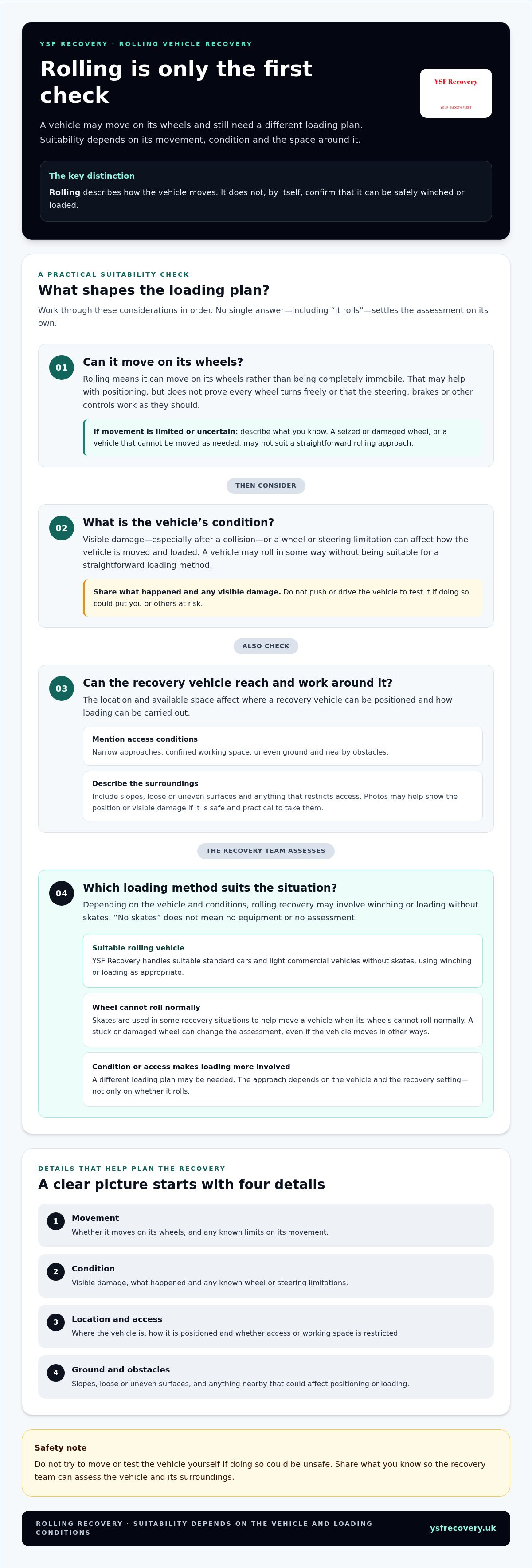
In practical terms, a vehicle is rolling if it can move on its wheels rather than being completely immobile. That movement may help with positioning it for recovery, but it doesn’t prove that every wheel turns freely or that the steering, brakes or other controls work as they should.
A vehicle with a seized or damaged wheel, or one that cannot be moved as needed, may not suit a straightforward rolling approach. Don’t try to test it by pushing or driving if that could put you or others at risk. Instead, describe what you know about its movement.
Recovery vehicles use different methods and equipment to lift, tow and transport vehicles. The general Tow truck overview describes some of these types and operations, but the right approach depends on the vehicle and the situation.
When Is Rolling Recovery a Possible Option?
YSF Recovery provides rolling recovery for suitable standard cars and light commercial vehicles that can be winched or loaded without skates. A vehicle’s ability to roll is a useful starting point, not a complete assessment. Its condition, position and the space available all affect whether it can be handled this way.
For example, a car that rolls but is tightly positioned, has visible damage or cannot be moved in a controlled way may need a different loading plan. A clear account of the vehicle and its surroundings helps the recovery team understand the task. Don’t assume that a vehicle is suitable just because its wheels turn.
After a collision, damage can affect movement even when the vehicle appears able to roll. Share what happened and any visible damage when arranging recovery. YSF Recovery also provides non-impound accident recovery for vehicles involved in a collision.
The practical distinction is simple: rolling describes how the vehicle moves, while suitability depends on whether it can be safely winched or loaded in its current condition and location. Providing accurate details helps set clear expectations for transporting a suitable car or light van to your chosen destination.
How Equipment and Loading Conditions Shape Rolling Vehicle Recovery
Being able to roll can make recovery more straightforward, but it doesn’t decide the loading method on its own. The equipment and approach need to suit the vehicle, its condition and the space around it. A clear area on firm, level ground presents a different task from a vehicle positioned on uneven ground or in a confined space.
Rolling vehicle recovery can involve winching or loading a vehicle without skates, depending on the circumstances. “No skates” doesn’t mean “no equipment” or “no assessment”. The recovery team still needs to consider how to move and load the vehicle in a controlled way, without assuming that its wheels or controls are fully functional.
What Can Affect the Loading Method?
The vehicle’s movement is one factor. If a wheel is damaged or the vehicle can’t be moved as expected, the loading plan may need to account for that. Access matters too: a narrow approach, restricted working space, uneven ground or nearby obstacles can affect where the recovery vehicle can be positioned.
Share what you know about the vehicle’s movement and the space around it. Photos can help show its position or visible damage, if it’s safe and practical to take them.
Why Do Some Recoveries Need Skates?
Wheel skates are used in some recovery situations to help move a vehicle when its wheels can’t roll normally. A vehicle that rolls may not need skates, but that depends on its condition and the loading circumstances. A stuck or damaged wheel can change the assessment, even if the vehicle can move in other ways.
There’s no single rule based only on whether a vehicle rolls. The aim is to choose a method that suits the vehicle and the recovery setting. YSF Recovery handles suitable standard cars and light commercial vehicles without skates, using winching or loading as appropriate.
Equipment guidance also depends on where an operation takes place. For context, OSHA standards for vehicle recovery equipment cover motor vehicles and mechanised equipment under United States construction regulations. They aren’t UK requirements, so technical or regulatory claims for UK recovery work should be checked against current official UK guidance.
Before arranging recovery, note whether the vehicle moves, any known wheel or steering limitations, and the conditions around it. Mention slopes, loose or uneven surfaces, tight access and obstructions. Don’t try to move the vehicle yourself if doing so could be unsafe.
YSF Recovery provides rolling recovery for suitable cars and light vans. Find out more about rolling recovery with YSF Recovery.
Rolling Recovery Compared with Non-Rolling and Skates-Required Recovery
A vehicle’s ability to roll describes its movement, not whether a particular loading method is suitable. This distinction avoids a common assumption: a car that moves on its wheels may still have damage, restricted movement or a position that makes loading more involved.
Rolling status and the need for skates are related, but they aren’t the same thing. Skates are used in some recovery situations to help move a vehicle when its wheels can’t roll normally. The recovery assessment considers both the vehicle and the conditions around it.
| Situation | Vehicle movement | Likely considerations | Recovery assessment |
|---|---|---|---|
| Rolling | The vehicle can move on its wheels. | Wheel condition, damage, steering or movement limits, position and access. | Whether it can be winched or loaded safely without skates. |
| Non-rolling | The vehicle cannot be moved normally on its wheels. | What prevents movement and how the vehicle is positioned. | Whether a different recovery approach or equipment is needed. |
| Skates required | Movement may be restricted at one or more wheels. | Whether the affected wheel or wheels can roll as needed for loading. | Whether skates are appropriate for the vehicle and situation. |
Rolling Versus Non-Rolling Vehicles
A rolling vehicle can move on its wheels, while a non-rolling one cannot be moved normally that way. A seized, damaged or obstructed wheel may prevent movement, so the recovery approach may need to account for that limitation. “Non-rolling” doesn’t describe one single fault or dictate one universal method. The reason it won’t move, its position and the available access all matter.
No Skates Needed Does Not Mean No Assessment Needed
YSF Recovery’s rolling vehicle recovery service covers suitable standard cars and light commercial vehicles that can be winched or loaded without skates. That doesn’t mean every rolling car or van can be loaded in the same way. Damage, how the vehicle moves and the space available can all affect the assessment. Report known limitations clearly, rather than assuming that wheels which turn freely are the only factor.
For instance, a vehicle might roll but have damage that affects its movement, or be positioned where access is restricted. In either case, rolling alone doesn’t settle the loading question. The operator needs to consider the actual conditions. A non-rolling vehicle may call for a different recovery approach, but that doesn’t automatically mean skates are the answer. Their use depends on the circumstances.
Describe what the vehicle can do, rather than just labelling it “rolling”. Say whether it moves, mention any known wheel or steering problems, and explain where it is positioned. These details help distinguish a suitable no-skates recovery from a situation that needs a different assessment.
What Information to Share Before Arranging Rolling Vehicle Recovery
Clear details help YSF Recovery understand the vehicle, the collection point and the planned destination. You don’t need to diagnose a fault. Describe what you can see and what the vehicle can or can’t do. This gives a practical picture of the recovery before loading is planned.
Use this checklist when arranging rolling vehicle recovery:
- Identify the vehicle. Say whether it’s a standard car or light commercial vehicle. The make and model can also help identify which vehicle is being recovered.
- Describe its movement. Explain whether it rolls, whether it can be moved as expected, and whether you know of any wheel, steering or other movement limitations. Don’t test it if moving it could be unsafe.
- Report its condition. Mention visible damage, including damage from a collision, and any other details that could affect movement or loading. Share what you’ve observed rather than trying to identify the mechanical cause.
- Give the collection details. Provide the vehicle’s location and explain how the recovery vehicle can reach it. Note restricted entrances, tight spaces, slopes, uneven ground or nearby obstacles.
- Set out the destination. Give the chosen delivery address and mention any access limits there. If it’s safe and practical, have the keys and relevant vehicle information ready.
Describe the Vehicle and Its Condition
Be direct about what the vehicle can do. “It rolls, but one wheel seems stuck” gives a clearer picture than simply calling it mobile. If it’s been involved in a collision, describe the visible damage and say whether its position or movement has changed. Don’t attempt a technical diagnosis or move the vehicle to gather more information.
Accurate detail matters because a vehicle’s ability to roll doesn’t, on its own, determine whether it can be loaded in the available space. If you’re unsure about a detail, say so. A straightforward description is more useful than a guess.
Explain the Collection and Delivery Requirements
Give clear collection and destination details, including anything that could affect access. For example, say if the vehicle is behind a narrow entrance or if there’s limited space to position recovery equipment. If you can safely take a photo of the location or visible damage, it may help you describe the situation. Don’t put yourself in danger to do so.
If the vehicle is beside a road, prioritise your safety and follow current official roadside guidance. Don’t stand in a dangerous position or attempt to direct traffic. Keep the essential details ready so you can explain the situation calmly.
YSF Recovery provides rolling recovery for suitable cars and light commercial vehicles. See rolling recovery with YSF Recovery and share the movement, condition, access and destination details above.
What to Expect from YSF Recovery for a Suitable Rolling Vehicle
YSF Recovery provides rolling vehicle recovery for suitable standard cars and light commercial vehicles that can be winched or loaded without skates. The service relocates the vehicle rather than repairing it or keeping it in storage. It’s transported to your chosen destination.
This can suit a car or light van that needs moving from a roadside, home or another collection point. The important question isn’t only whether the wheels turn. The vehicle’s condition and the space available for loading also shape what can be done safely. Clear information helps set practical expectations before the move.
Who May Need Rolling Vehicle Recovery?
Drivers may need to relocate a road-capable car or light van that shouldn’t continue its journey, or arrange a move after an incident. If a vehicle has been involved in a collision, describe its visible condition and movement limits when arranging recovery. YSF Recovery also provides non-impound accident recovery, while the rolling service is for vehicles suitable for winching or loading without skates.
Recovery is distinct from repair work. It moves the vehicle; it doesn’t fix a mechanical fault or address damage. It isn’t a storage service either. Knowing this scope helps you decide whether transport to your chosen destination meets your immediate need.
Arrange a Recovery with Clear Information
When arranging recovery, give a clear account of how the vehicle moves, its condition and where it can be reached. Explain any restricted access or limited working space, then provide the delivery destination. You don’t need to diagnose a fault. Straightforward observations help the team understand the job and plan the loading approach.
If the vehicle rolls but has a known movement limitation, mention it rather than describing the vehicle simply as mobile. Likewise, note visible damage or an obstacle near the vehicle. These details help distinguish a straightforward loading situation from one that needs closer consideration. Keep the keys and relevant vehicle information ready if it’s safe and practical to do so.
YSF Recovery offers relocation for suitable rolling cars and light commercial vehicles without skates, with transport to your chosen destination. The service covers recovery and transport, not vehicle repairs or storage. Plan for the vehicle to be delivered where you need it rather than held for later collection.
To arrange recovery, contact YSF Recovery with the vehicle’s condition, collection access and chosen destination details.
Make Your Next Move with Confidence
A recovery enquiry is easier to arrange when you focus on what you know: where the vehicle is, how it moves, what condition it’s in and where it needs to go. You don’t need to work out the cause of a fault or choose the loading method yourself. Clear observations give the recovery team a useful starting point.
For suitable cars and light commercial vehicles, rolling vehicle recovery with YSF Recovery provides relocation without skates and transport to your chosen destination. Share any movement limits or access restrictions at the outset so the team has a clear picture of the job.
Ready to move a suitable vehicle? Arrange rolling vehicle recovery with YSF Recovery and provide its condition, collection details and destination.
Frequently Asked Questions
What is rolling vehicle recovery?
Rolling vehicle recovery moves a vehicle that can travel on its wheels onto or towards a recovery vehicle for relocation. The term describes movement, not a guarantee that loading will be straightforward. For example, a car may roll but be parked close to a wall, limiting access. Its condition and position still matter when deciding how it can be handled safely.
Can a rolling car be recovered without skates?
Yes, a suitable rolling car can be recovered without skates, but its ability to roll isn’t the only factor. A damaged wheel, restricted movement or tight collection space can affect loading. YSF Recovery handles suitable standard cars without skates. Describe any known limitations and access restrictions so the recovery team has a clear picture before the vehicle is moved.
What does it mean if a vehicle is non-rolling?
A non-rolling vehicle can’t move normally on its wheels. A wheel might be seized, damaged or blocked, or the vehicle may be stuck in a position that prevents it from moving. The term describes what the vehicle can do, not why it can’t move. Share what you’ve observed, such as a wheel that won’t turn, without trying to diagnose or force movement.
Can a damaged car still be rolling?
Yes. A car may still move on its wheels despite visible damage, such as a damaged bumper or body panel. But movement doesn’t prove that it’s suitable for a particular recovery method. Damage near a wheel or underneath the car could affect loading. Don’t drive or push it to test this. Describe the visible damage and any movement you’ve noticed when arranging recovery.
What information should I give when arranging rolling vehicle recovery?
Give the vehicle’s make and model, its collection location and whether it moves on its wheels. Mention visible damage or known movement problems, plus anything that restricts access, such as a narrow entrance or limited space. Provide the chosen destination and note any access considerations there too. If it’s safe and practical, have the keys or a photo of the vehicle’s position ready.
Does rolling vehicle recovery include repairs or storage?
No. YSF Recovery provides vehicle recovery and transport, not mechanical repairs or vehicle storage. The service moves a suitable vehicle from its collection point to your chosen destination. If the car needs attention after arrival, that work isn’t part of the recovery itself. Share the destination details when arranging the move so the vehicle can be transported where you need it to go.


